A day out at Kaingo:
Updated: May 6
We set off before sunrise from Bushwillow camp. Making sure to enjoy a hot coffee and rusk at the lodge before setting off to Ant’s main property to collect our two guests from Ireland. Dawn hadn’t broken yet, the skies were silent, even the birds were still tucked away in the safety and warmth of their nests.
On entering the main section we were already met by a herd of buffalo with a few young calves scattered amongst the group. Slowly but surely the sky above us began to awaken into a deep-set blue. We rounded our way past Ant’s house and sure enough right around the next bend was the so called ‘Tag Team’, a crash of 5 white rhino, red-dust coated, making them appear almost russet in the morning light.
On arrival to Ant’s Nest, we greeted our two guests who were to accompany us on our adventure. We then trotted towards the kitchen, following the scent of freshly baked croissants, to pick up our hot box and packed breakie. Once the breakfast was safely secured in the boot, we were on our way. The whole journey I was harshly taunted by the sweet scent of these baked goods sitting patiently in the back. So close yet so far.
Not far along the sandy main road out of the Nest, a mound of freshly dug-up sand caught our eye. Out we all hopped as Calvin, our lead Guide, interpreted the intricacy of the Aardvark’s nightly activities. He pointed out an indentation in the sand on either side of the imprinted tail mark and began to explain the fact that despite the myth told by many that this was the imprint of the aardvark’s testicles (and a way of telling whether this was a male or female) - that it was actually in fact a scent pouch situated in this exact position. He then continued to scoop up the sand where the sac must have sat, into his cupped hands. Then proceeded to approach us intrigued onlookers with this lump of sand, getting us each to give this prized scoop of sand a sniff. To my relief it wasn’t as bad smelling as the aardvark’s scat – which despite being made up solely of termites and ingested sand grains – smells rather gruesome. This little lump of sand however smelt distinctly of popcorn – just like that of leopard’s urine. However, I’d far rather be smelling the sweet scent of the croissants in the back of the cruiser.
With our senses heightened we swiftly got back in the cruiser to continue our journey towards Kaingo. We exited Ant’s gate, making sure to spray the tyres with Foot & Mouth disinfectant and stand in the little box to clean our shoes off as well. We were all glad to be on tar road for once and enjoyed a few minutes of smooth driving. Out of nowhere, our one guest remarked that she was sure she’d just seen a big cat along the fence line opposite us. I’d just seen an impala but not to dull the anticipation of an exciting sighting I just sat silent as we did a full 180 turn back on ourselves and careered up the tar where this supposed creature was spotted. Sure enough a few moments later we were headed back in the right direction, no cat to be seen. The tar came to an end and we were back on bumpy dirt road, passing game farms and pecan nut farms.
Eventually the entrance to Kaingo appeared on our right, two seemingly struggling baobab trees guarding the entrance. We set about transferring our goods from the safety of the closed cruiser to the open game viewer. I was certain the aroma that our vehicle would be setting off would have the animals finding us rather than us finding them. With no time to waste we were off into the reserve, ‘Calvin and Anya going mobile from Ant Africa Safaris via Tamboti Gate’. I chuckled to myself at how formal this sounded.
Soon enough two tsessebe were spotted in the tall golden grass a fair distance from us, a rustle in the grass and a twitch of ears turned the two into three, or two and a half rather as a tiny tsessebe calf clung as close as possible to the safety of its mum.
Our first stop of the day was ‘Pride Rock’ which sounded like a promising spot. Here giant domes of sedimentary rock rose out of the hill side. I was later to discover that these structures were formed via solidification of ancient sand dunes that covered the area millions of years ago. Due to the sedimentary base on which the Waterberg stands, our landscape is composed of mainly sourveld species that form on the nutrient-poor soils. Here acidic-tolerant flora manage to thrive, with prominent species including Terminalia, Combretum, Grewia and Burkea trees. This terrain also seems to yield many wildflower and herb species such as Wild Basil, Wild Hibiscus & Wild asparagus – things seem to be very wild out here. A short walk led us up to one of the 15 rock art sites on the reserve. Here, painted intricately into one of the sandstone walls were a set of brick red bushman that appeared to be in the midst of some sort of ritual. The rock art sites here are dated all the way back to the Stone Age, when the San (Bushmen) roamed the land. What was incredible to me was the rich colour of these paintings, so well preserved, so durable against the test of time and elements. To make their unique paint, the San people ground up a type of iron-rich rock called Ochre, using pestle and mortar. This resulting powder was mixed with a binding agent such as animal fat, blood (often from Eland antelope) and egg white, to complete the concoction. To apply the paint to the stone face, the San made makeshift paint brushes using animal hair, bird feathers and fine sticks. I’ve been lucky enough to see many rock paintings over various locations across South Africa and Zimbabwe - these particular figures were however depicted in a different manner to what I’d previously seen.
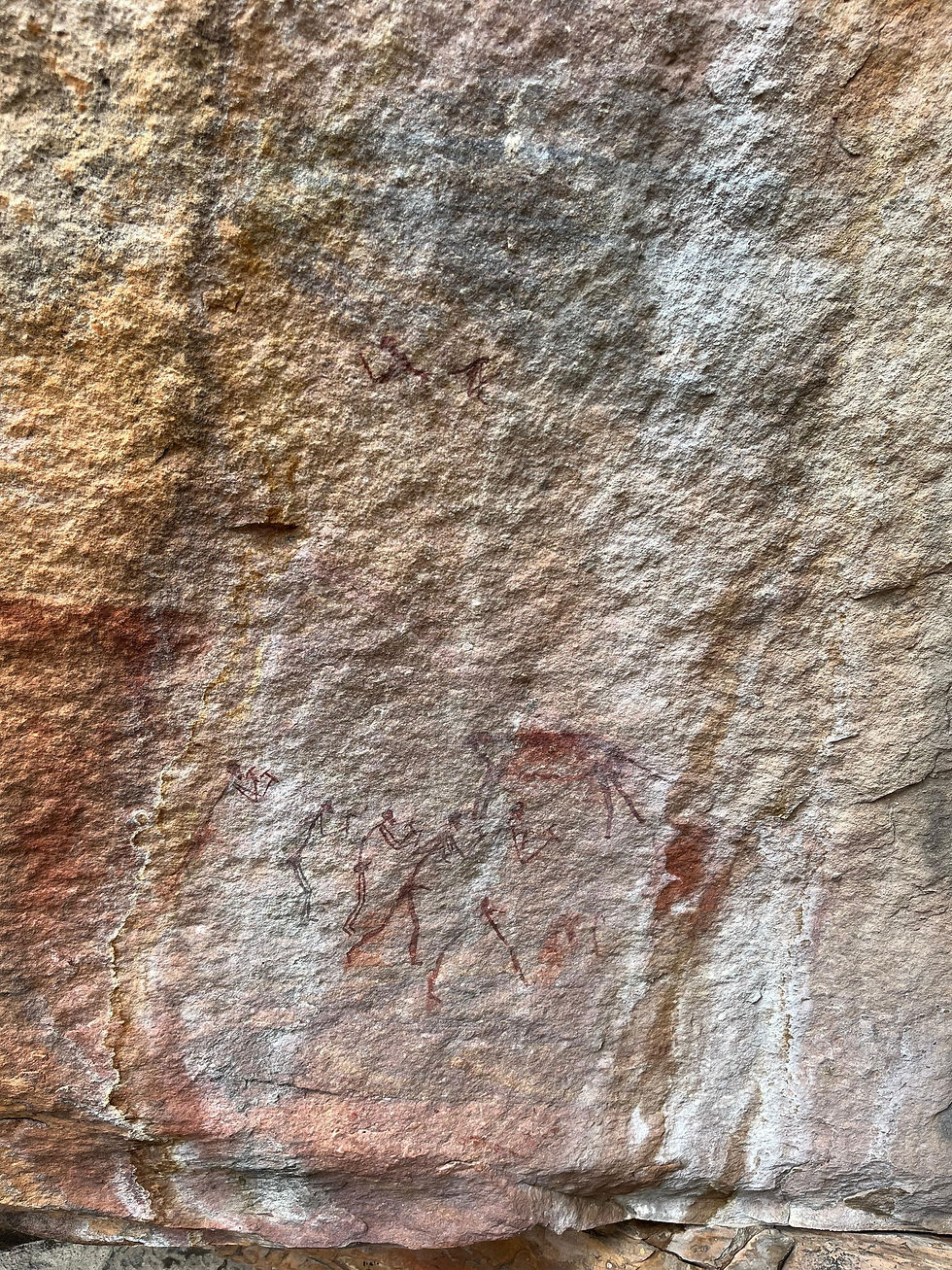
These figures appeared to be in what is known as the ‘Trance Dance’, whereby Shamans or Spiritual leaders were believed to enter altered states of consciousness to communicate with spirits and the ancestral world. This altered state was believed to allow them to heal the sick, control the weather and ensure successful hunts.
The San people are one of the oldest known cultures on Earth, dating back to 20 000 years ago. They were ‘Hunter-Gatherers’, known for their skill in tracking and hunting game as well as foraging for edible plants, making use of their leaves, roots & fruit as a means of nutrition. Along with the remains of their Rock art, also found in the vicinity were their rock tools including flints, grinding stones and skinning tools. What I learnt here was a term called ‘The bulb of percussion’, which is essentially a distinctive feature on the surface of a flake, formed as a result of the force applied during the process of ‘flintknapping’ (shaping flint). The presence or absence of a ‘bulb of percussion’ is a key criteria used by archaeologists to distinguish between naturally fractured stones and those that have been intentionally shaped by humans.
A rather green and flaky tree growing incongruously between the rocks caught my eye – I knew immediately it must be a Commiphora of sorts and indeed it was a Green-stem Corkwood. Intertwined amongst its peeling branches - that looked very much like me the last time I had too much sun - was a rambling vine carrying fairly large fruits, similar in size to that of a monkey orange. This was the Wild Calabash, Lagenaria sphaerica, which is apparently unpalatable, very bitter and used by Zulu women to help in the weaning process, discouraging babies from suckling due to its bitter taste. I was immediately put off trying the fruit that despite this knowledge looked like a promising, luscious melon like meal.
It was time to leave Pride Rock, with what seemed like a wealth of new knowledge. Over the radio we heard news of a sighting of two bull ndlovu’s. With our guests never witnessing these giants before, we headed in their direction. Along the way we were met by a rather large troop of baboons. They covered an extensive grassy area which encircled a sprawling Weeping Boer bean. We sat with them for a while, highly amused at their antics and playful behaviour, as though we were witnessing some sort of circus act. Swinging from the branches and landing back in the grass with seemingly no effort at all. Some idled in the grass below, forming grooming stations whilst mothers of the group strolled around with babies attached to either front or back. This nature is dependent on age and for the first 5-6 weeks the babies will remain clinging to their mother’s belly for warmth, protection and easy access to milk. From then on, the infant begins to climb onto its mother’s back, riding ‘jockey style’. Only fully weaning at 6-8months. What was interesting to notice was the ‘Scout’ of the group. Usually the alpha male, who remains a distance from the main bunch, and from an elevated position, overlooks and surveys the area for any immediate danger. And there he was settled nicely into his own personal Silver Cluster Leaf, his spot from where to scan the surrounding land.
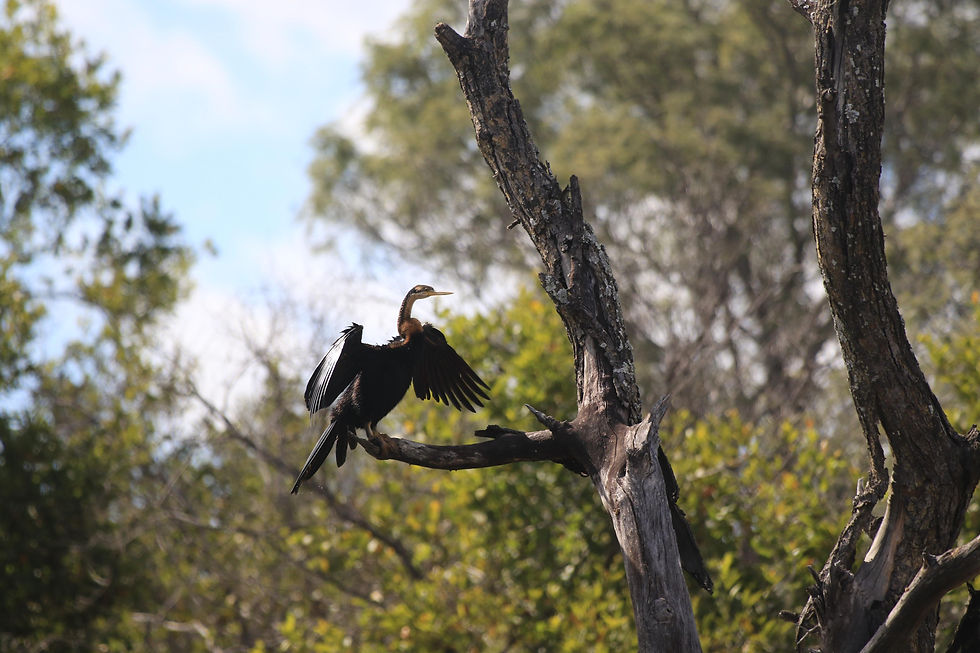
Once we’d left the circus station behind, we passed by Lily Pan which seemed to be home to an abundance of bird life. In particular, an African Darter sat with his back to the sun and wings widely spread in an attempt to dry himself out post dive.
We eventually reached the location of the recorded Ndlovu sighting. With the car switched off, we listened silently for evidence of breaking branches. Soon enough we heard a crack and crunch, the destruction seemed to be coming from the middle of the block, amidst thick scrub and like usual, these giants seem to be able to disappear with ease into the bush.
With our attention totally focussed on spotting the ellies, our eyes seemed to evade a golden figure which sat poised and proud under a Terminalia tree. I was simply soaking up the rays of the early morning sun, my eyes momentarily shut as I savoured the moment of pure bliss. When one of our guests remarked the fact there was something under the tree. Cheetah!! I squealed as calmly as possible, elated at the fact that we were in the presence of my favourite mammal.

I couldn’t believe our luck, I thought to myself that it was funny how our search for one thing led us to the discovery of another. Sitting there silently was probably the most well-fed cheetah I’ve ever seen. He must have made a kill and engorged himself only recently as his stomach bulged beneath his long and lean body. He stared on to a couple kudu only a hundred metres or so in front of him but remained completely unbothered by the presence of food strolling by. He stretched his agile front legs in front of him, arched his back and then continued on his way for a couple steps, with his extra pounds weighing him down, decided it was far enough and suitable for a lie down. And so suddenly surrounded by the tall grass he’d already vanished out our sight - I thought then that if we’d driven past just a few moments later, or if we hadn’t stopped to listen out for the ellies, that we’d never been blessed by the sight of this magnificent endangered species. This up and down continued repeatedly as he slowly made his way down the grassland, with numerous bouts of rest in-between. We must have sat watching him for more than half an hour, not wanting to lose sight of him as he began to slip away into the undergrowth. I believe this was a lesson in the importance of ‘stillness’ and how slowing down lets you see what was always there.
By this point we’d completely forgotten about our original mission in finding the two ellies, although the rumbling of tummies in the back seats sounded ever so elephant like. It was time for a breakie break. We rounded the block and parked alongside the road and wasted no time in unpacking the various goods; hot box, cool box & snack bags. It all seemed to keep piling out of the game viewer like a Mary Poppins bag. Soon enough we had a whole buffet spread across the bonnet of the vehicle. I eyed out the croissants, it was finally time, I savoured the buttery, flaky goodness whilst sipping on a much needed hot chocolate. Then it was time for an egg and bacon toastie which seemed to be out of sight as soon as it was in my hands. With bellies full just like that of the cheetah we gingerly climbed back into the vehicle and cruised off back to where we had originally heard the elephant activity. Sure enough, as we approached, there was one bull appearing in perfect timing out of the brush, using his trunk to scent the fresh air that we had now tainted. He seemed almost shy at our presence and retreated shortly back into cover.
We positioned the cruiser adjacent to a game path that looked well worn and that we predicted they would soon move across. We switched off the game viewer and waited for the ellies to come to us rather than us to them. This is the most ideal sighting you could ask for, where the animal feels safe enough to continue with his daily tasks and doesn’t feel in any way threatened by our presence. One by one they emerged from the thicket, and continued to forage for food, occasionally glancing over at us with the most gentle eyes that displayed no sign of threat or annoyance. The larger of the two seemed intrigued by our presence and slowly began to approach our vehicle, stopping only a couple metres from us. Ears only flapping as a means to cool himself down in the ascending heat. He stopped, positioning himself side-on to the vehicle, as a way of sizing us up, and he clearly won this feat. He was in such close proximity that I could see the dust and sticks that lay on top his giant being.

I could watch his every step as his feet expanded on impact with the solid ground, as his thick skin absorbed any trace of sound. He began to paw at a small shrub, de-rooting it with his front foot and then grasping it with his incredibly flexible trunk, passing it with ease into his mouth. Satisfied with his snack, and content that we posed no threat, he followed his friend across the road where we were parked, and they both continued on with their day.
It’s hard to imagine ever growing tired of watching these creatures, or any of these creatures for that matter. The more time you spend with them, the more you begin to realise just how much they have to teach us. They move through life with a sense of calm that we can only imagine having, maybe that’s because nature is never in a rush, never thinking too far into the future. Only present and focussed on what they are in need of right there and then. Facing challenges only when they arise, not imagined in advance or carried unnecessarily. Everything unfolds in its own time.
- Kaingo 3/04/26
Comments